






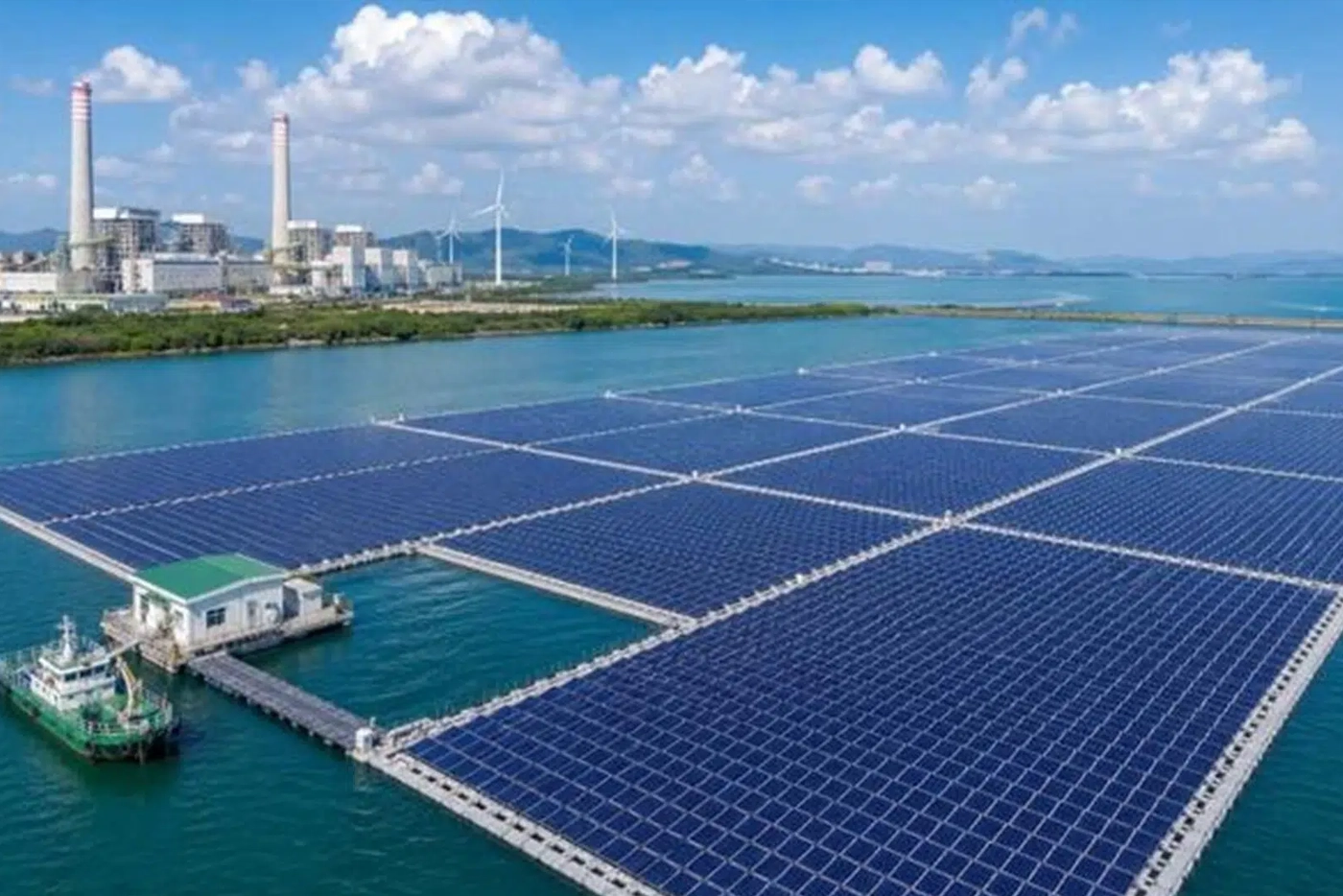

Floating solar power has just taken a major step forward thanks to an innovative project developed in Taiwan. A recent study has shown that solar plants installed at sea can generate up to 121% more electricity than traditional land-based photovoltaic installations, while also offering greater long-term profitability.
The breakthrough is sparking enormous international interest because it could transform the way renewable energy is produced in countries with limited available land. Experts consider this technology to be one of the most promising solutions for accelerating the energy transition without occupying large land areas.
How does floating marine solar energy work?
Floating solar energy consists of installing photovoltaic panels on floating structures located in reservoirs, lakes, or directly on the sea. In the case of the Taiwanese project, the plant was developed in a protected bay within a coastal industrial zone.
The main finding of the study is that the marine environment significantly improves the performance of solar panels. The water and air currents act as natural coolants, preventing photovoltaic modules from overheating.
This is especially important because solar panels lose efficiency when they get too hot. Thanks to the cooling effect of water, floating systems can operate under more stable conditions for more hours a day.
Taiwan demonstrates that the sea can produce more energy than the land
Research conducted by scientists at Taipei National University of Technology directly compared a land-based solar plant and a marine floating solar facility using the same reference capacity of 100 MWp.
The results were overwhelming:
- The floating power plant generated 12% more electricity.
- The reduction of CO₂ emissions was higher.
- Net profitability ended up being higher despite higher operating costs.
- Energy stability improved thanks to favorable sea conditions.
Researchers highlight that the project demonstrates the real feasibility of moving part of the renewable energy production offshore, especially in densely populated territories or those with land scarcity.
The major problem with ground-mounted solar power: available space
One of the biggest challenges in expanding solar energy is the enormous surface area required by traditional photovoltaic plants. Countries like Taiwan, Japan, South Korea, and Singapore have limited available territory and strong restrictions on building large solar farms without affecting agricultural, urban, or natural areas.
Marine solar energy helps solve part of this problem by utilizing water surfaces already altered by human activity or maritime zones near industrial and coastal areas.
Furthermore, floating plants can be located near large energy consumption centers, reducing electricity transportation costs and improving grid efficiency.
Technical challenges of installing solar panels at sea
Although the advantages are significant, floating offshore solar energy also presents considerable technological challenges. The marine environment is much more aggressive than land-based installations due to:
- Salinity and humidity corrosion.
- Impact of waves and storms.
- Accumulation of bird droppings and waste.
- Need for flexible and resistant structures.
Researchers estimate that building an offshore solar plant can cost approximately 30% more than a conventional onshore facility. However, the increase in energy production and improved efficiency offset a significant portion of those costs over the project’s lifespan.
Offshore solar and wind energy: the combination that can change the energy future
Many experts believe that the future of renewable energy will involve combining floating solar power with offshore wind farms that are already in operation in many countries.
The advantage of this hybrid system is that it allows for better energy production balance:
- When the wind decreases, solar radiation usually increases.
- When solar production drops, wind can maintain electricity generation.
This improves energy stability and reduces reliance on fossil fuels or storage systems.
Europe and Asia accelerate investments in floating solar energy
The success of the Taiwanese project is driving new developments in various countries. China, the Netherlands, Germany, and Japan are already working on floating technologies capable of withstanding extreme maritime conditions.
Europe is also increasing investments in this sector as part of its energy transition and decarbonization strategies.
In addition to producing clean electricity, floating solar energy could reduce land use conflicts and limit the visual impact of large ground-mounted solar plants.
The future of renewable energy could be at sea.
Floating solar energy is still in its early stages of expansion, but the results obtained in Taiwan reinforce the idea that the sea can become a new global energy frontier.
The combination of greater efficiency, reduced emissions, and better space utilization makes this technology a particularly attractive alternative for coastal countries and densely populated regions.
Experts agree that innovation in materials, maintenance, and floating structures will be decisive in reducing costs and accelerating the deployment of these plants in the coming years.
With increasingly advanced and efficient projects, offshore solar energy is beginning to establish itself as one of the major bets for the future of renewable energy.