






Germany revolutionizes solar energy with a panel that achieves a record efficiency of 34.4%
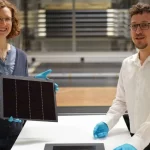
The global race to develop more efficient renewable energy has just taken a historic step. A team of German researchers has succeeded in creating the most efficient solar panel ever developed for terrestrial applications, achieving an impressive 34.4% energy efficiency, a figure that could completely transform the future of photovoltaic energy.
The breakthrough was led by scientists from the prestigious Fraunhofer Institute for Solar Energy Systems (Fraunhofer ISE), one of Europe's leading renewable energy research centers. Their major innovation lies in combining technologies originally developed for space exploration with a novel architectural design that maximizes the use of every centimeter of solar surface.
The result is a panel capable of producing much more electricity using less space, an aspect that is especially important in cities, buildings, and electric vehicles.
What does it mean for a solar panel to have 34.4% efficiency?
The efficiency of a solar panel indicates the amount of solar energy it is able to convert into useful electricity.
For example:
- A panel with 20% efficiency transforms 20% of the solar energy it receives into electricity.
- The rest is lost as heat or is simply not used.
Currently, most of the most advanced residential solar panels on the market have an efficiency of between 22% and 25%. Therefore, achieving 34.4% represents a huge technological leap, exceeding the performance of many conventional photovoltaic systems by approximately 40%.
This improvement would allow much more energy to be generated using the same installed surface area.
The key lies in a technology used in space satellites
The most surprising thing about this development is that the technology used was not created with homes or cities in mind, but rather with space in mind.
The researchers used solar cells known as multi-junction III-V, a type of semiconductor that has been used for years in satellites and space missions due to its extraordinary ability to capture solar energy.
Unlike traditional silicon cells, these structures are composed of several overlapping layers.
Each layer is designed to absorb a different part of the solar spectrum:
- Ultraviolet light.
- Visible light.
- Infrared radiation.
Thanks to this multi-layer system, a greater amount of energy is harnessed that would normally be wasted in conventional panels.
The Shingled Matrix design: the other big secret of the record
The second major innovation is the architecture called Shingled Matrix, which could be translated as "tile-shaped matrix".
Instead of placing the solar cells in a traditional way, the researchers have arranged them in an overlapping manner, mimicking the placement of roof tiles.
This design offers multiple advantages:
Eliminates shadows caused by metal contacts
Conventional solar panels incorporate small, visible metal lines that conduct the generated electricity. However, these structures also create shadows that reduce solar energy capture.
The new technology hides these connections on the back.
It makes use of virtually 100% of the surface area
By reducing dead zones, the entire sun-exposed surface becomes an active energy-harvesting surface.
Reduce electrical losses
The distance that electricity must travel within the panel decreases considerably, improving the overall efficiency of the system.
Where will this technology be used first?
Although the discovery is revolutionary, we will not yet see these panels installed massively in homes.
There is one major obstacle: the cost.
III-V cells are much more expensive to manufacture than traditional silicon cells, as their materials were originally designed for aerospace applications.
Therefore, the first sectors that could benefit will be those where available space is especially valuable.
1. Smart buildings and photovoltaic facades
Skyscrapers and modern buildings could incorporate these panels directly into their facades, transforming the exterior skin of the buildings into veritable urban power plants.
2. Houses with small roofs
Many homes do not have enough surface area to cover all their energy demand using conventional panels.
With this technology, the problem could disappear.
3. Electric vehicles
Electric car manufacturers are also watching this development with great interest.
Integrating ultralight and ultrapowerful solar panels into roofs and car bodies could provide extra kilometers of range without significantly increasing the weight of the vehicles.
A breakthrough that could accelerate the global energy transition
German innovation arrives at a crucial moment.
Global demand for electricity continues to grow, and governments are seeking sustainable alternatives that reduce dependence on fossil fuels.
Until now, much of the strategy has involved installing huge expanses of solar panels.
However, this discovery represents a paradigm shift: instead of occupying ever more land, the goal will be to produce much more energy using much less space.
This could be especially beneficial in urban environments, where every available square meter has great economic value.
When could these solar panels arrive in homes?
Experts have not yet set a specific date.
The technology is currently in a transition phase between the laboratory and pilot industrial production.
The main challenge will be to reduce manufacturing costs to make it competitive against current systems.
The evolution could follow a pattern similar to that of other technological innovations:
- Initial application in premium sectors.
- Expansion into specialized industries.
- Gradual entry into the residential market.
If this process accelerates, the next decade could mark the beginning of a new generation of much more efficient solar panels.
One small step for the space industry, one giant leap for terrestrial energy
The history of innovation is full of technologies born in very specific sectors that end up transforming everyday life.
The internet, GPS, and digital cameras are some examples.
Now, solar energy could be the next big revolution to benefit from technology transfer from space to our homes.
Germany has just demonstrated that the future of energy does not necessarily lie in building more panels, but in building much better panels.