






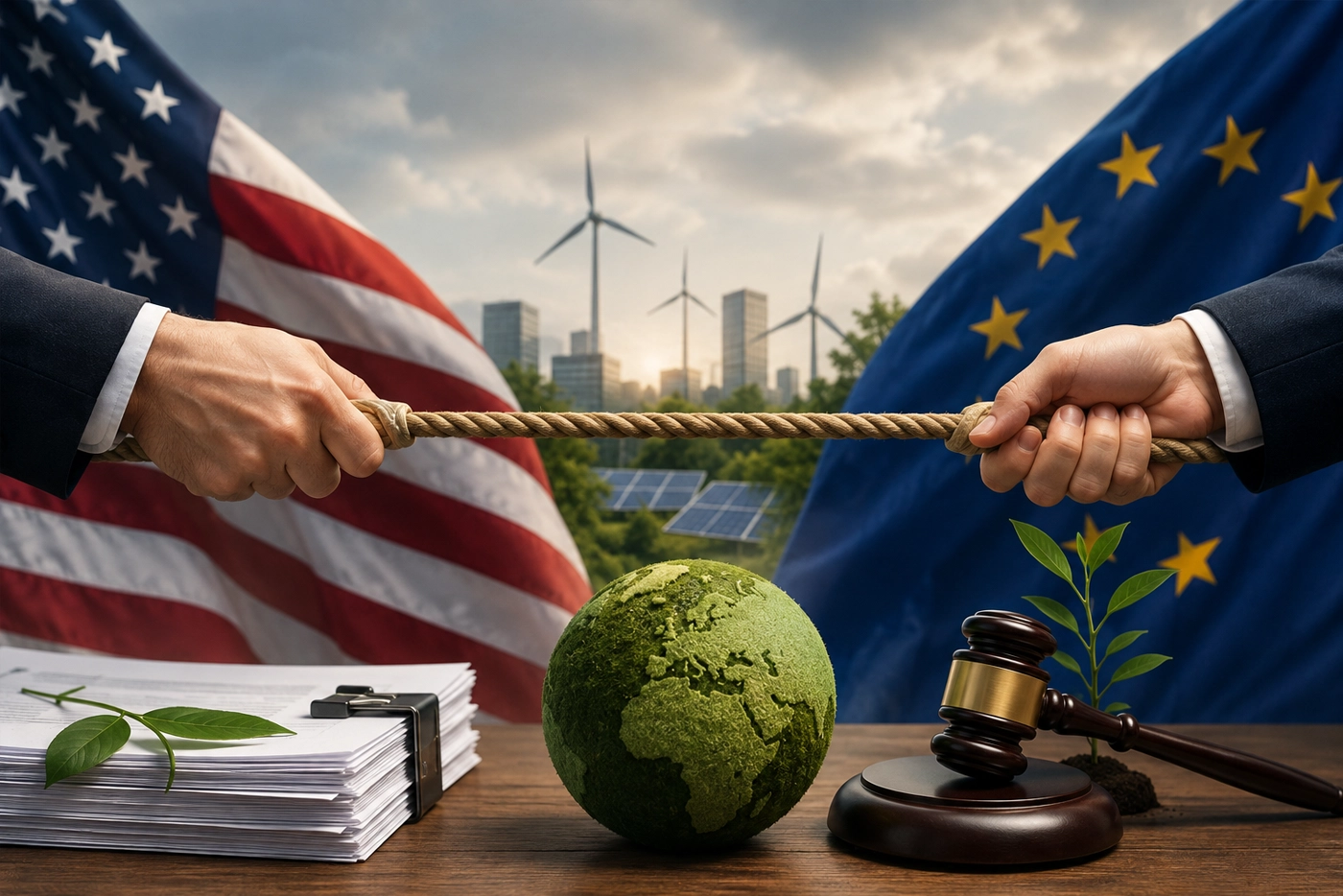
The trade battle between the United States and the European Union is entering a new arena: that of corporate sustainability legislation.
In recent weeks, Washington has increased pressure on Brussels to reduce the scope of some European rules that require large companies to report on their environmental and social impacts and to identify human rights and environmental risks in their supply chains.
The debate particularly affects two fundamental pieces of the European regulatory framework: the Corporate Sustainability Reporting Directive (CSRD) and the Corporate Sustainability Due Diligence Directive (CSDDD).
The issue goes far beyond a technical dispute about corporate bureaucracy. At stake is the model Europe wants to apply to corporate environmental responsibility and the extent to which these rules can affect foreign companies operating in the European market.
Washington demands more concessions from Brussels
The United States believes that certain European obligations have extraterritorial reach and may impose additional costs on US companies.
The US ambassador to the European Union, Andrew Puzder, has called on Brussels to amend European sustainability rules and indicated that Washington expects the EU to honor its commitments regarding non-tariff trade barriers. Reuters reported on August 14 that the United States is specifically pressing for changes to the CSRD and the CSDDD.
Among the US demands are limiting the scope of certain obligations on US companies and preventing European rules from being broadly applied to their activities outside the EU.
The pressure also extends to other European environmental measures, including the Carbon Border Adjustment Mechanism (CBAM), one of the tools through which the EU intends to prevent imports from countries with lower climate requirements from creating a competitive disadvantage for European producers.
Europe has already reduced some of its requirements
However, the US pressure comes after the European Union itself has undertaken a major review of its sustainability legislation.
Brussels approved Omnibus I in February 2026, a legislative package aimed at simplifying corporate reporting and due diligence obligations and reducing the administrative burden for companies. The EU Council confirmed the reform's final approval on February 24.
The new legislation modifies the scope of the CSRD and the CSDDD and aims to limit the so-called "cascade effect" whereby the obligations of large companies ended up affecting smaller companies integrated into their supply chains as well.
The European Commission estimates that simplification measures related to sustainability reporting, due diligence and other rules could generate administrative cost savings of around 4.5 billion euros per year.
Therefore, the current debate does not start from an intact European legislation. The framework has already been significantly reduced compared to the initial proposals.
What are CSRD and CSDDD?
The CSRD sets out the rules by which certain companies must report on sustainability-related issues, including environmental, social and governance aspects.
Its aim is to improve transparency and allow investors, consumers and other stakeholders to better understand the impacts and risks associated with business activity.
The CSDDD, for its part, focuses on due diligence. Its aim is for large companies to identify, prevent, mitigate, and address certain negative impacts on human rights and the environment related to their activities and value chains. The European directive originally came into force in July 2024 and was subsequently amended by simplification legislation passed in 2026.
Both standards are part of the European strategy to integrate sustainability into the day-to-day operations of companies.
The US argument: competitiveness and regulatory sovereignty
Washington's position is based primarily on concerns about the costs that these obligations may generate for American companies operating in Europe.
The United States argues that certain European requirements can become de facto trade barriers and demands that US companies be protected from certain extraterritorial effects of EU legislation.
The argument connects to a broader question: how far can the European Union go in establishing rules that condition the activity of foreign companies when they want to access its market?
For Brussels, however, the ability to set its own rules is a matter of regulatory autonomy.
European sustainability is at a crossroads
The situation reflects one of the major dilemmas currently facing European environmental policy.
On the one hand, the EU aims to maintain high standards in terms of sustainability, environmental protection, human rights and business transparency.
On the other hand, European institutions are trying to reduce the bureaucratic burden and improve the competitiveness of EU companies against the United States, China and other economies.
The simplification approved in 2026 is precisely a response to that second concern. The EU Council has defended the reform as a way to reduce the administrative burden and strengthen European competitiveness without abandoning the fundamental objectives of sustainability policy.
The problem is finding the balance.
Reducing obligations can facilitate compliance and lower costs, especially for companies that find reporting and due diligence requirements overly complex. However, excessive reduction could also limit the legislation's ability to ensure that environmental and social impacts are truly identified.
A dispute that goes beyond the United States
The confrontation between Washington and Brussels also has implications for the entire global market.
European sustainability legislation has traditionally had an impact that extends beyond the borders of the Union. Multinational companies wishing to operate in Europe must adapt to certain EU standards, which can ultimately extend these requirements to their suppliers and business partners.
This has made the EU one of the world's leading players in setting regulatory standards related to sustainability.
The question now is whether Europe will continue to use that regulatory power as a tool to drive the transition to a more sustainable economy, or whether pressure to improve competitiveness will lead to a further reduction in its requirements.
Europe will have to decide how far simplification can go.
US pressure adds a new dimension to a debate that was already open within the European Union itself.
The simplification of the CSRD and CSDDD demonstrates that Brussels is willing to review its rules when it believes they may impose an excessive burden on businesses. However, European institutions have also made it clear that regulatory autonomy is not up for negotiation.
The outcome of this dispute will be relevant not only for American and European companies. It could also determine the evolution of the European model of corporate sustainability in the coming years.
The fundamental question is simple, but its consequences are enormous: can Europe reduce business bureaucracy without simultaneously reducing its environmental ambition?
The answer will shape much of European sustainability policy in the coming years.