






The renaturalization of the European bison: from the brink of extinction to protagonist of the European landscape
Spain, Portugal, and Poland are exploring different paths to recover the great European herbivore, while the scientific debate grows about its role in current ecosystems.
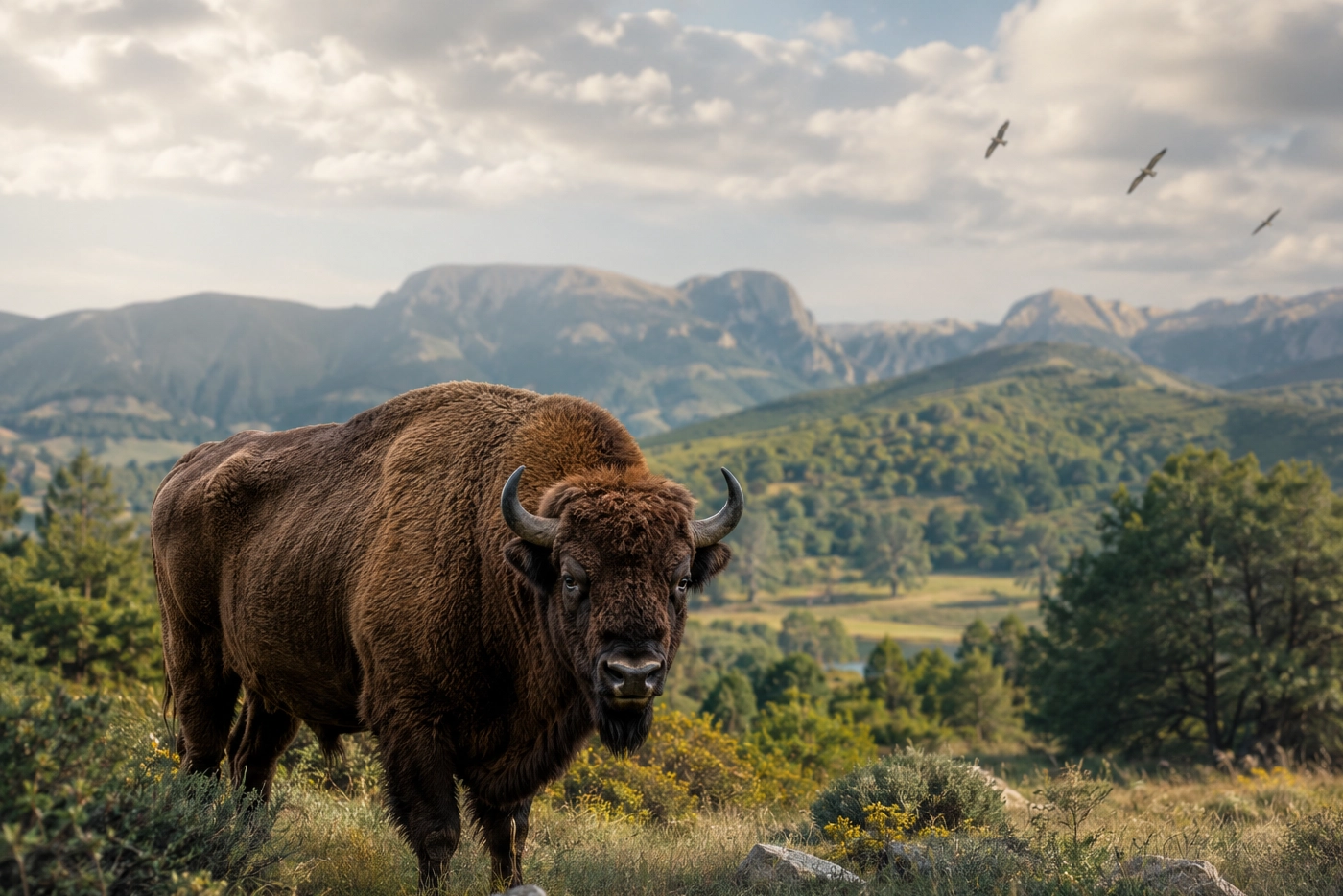
For centuries, the European bison was virtually doomed to extinction. Hunting pressure, habitat transformation, and the loss of vast natural areas reduced its populations to the brink of extinction. Today, however, its story is one of the greatest recoveries in European wildlife conservation.
Around 10,000 bison now live in Europe, with more than 7,000 roaming freely in various countries. The species' recovery has allowed the bison to reclaim territories from which it had disappeared and has made it one of the emblematic animals of the rewilding movement.
Poland, one of the great refuges of the bison
Poland occupies a central place in this story. The country maintains some of the most important populations of European bison, and numerous specimens have been transferred from there to other European territories as part of conservation programs.
The first eight European bison to be transferred to Portugal arrived in 2024 from Polish reserves. The project, developed at Herdade do Vale Feitoso in the Castelo Branco district, marked the species' first arrival in the country. The animals were relocated from reserves in Poland with support from the European Bison Conservation Centre.
The goal is not only to conserve the animal. The presence of large herbivores can modify the structure of the vegetation, favor certain habitats, and contribute to creating more diverse landscapes.
Portugal: a large-scale rewilding experiment
In Portugal, the project has a particularly interesting dimension because the bison is incorporated into a broader strategy for the recovery of natural processes.
The eight bison introduced to the Herdade do Vale Feitoso have a space of approximately 7,600 hectares and share the territory with other large herbivores, such as taurines. The initiative aims to study how the bison adapts to the Mediterranean climate and landscape and what effects it has on the vegetation.
One of the hypotheses being studied is their possible contribution to reducing combustible vegetation. By feeding on grasses, shoots, and other vegetation, large herbivores can maintain more open areas and create discontinuities in the landscape that hinder the spread of some fires.
The Portuguese project, however, is conceived as a pilot project. The animals are monitored to understand their adaptation and evaluate the effects before considering any larger-scale interventions.
Spain: The return that generates the most controversy
Spain represents one of the most debated cases.
The European bison is currently involved in various private and conservation initiatives, with particularly well-known projects in Castile and León. In San Cebrián de Mudá, Palencia, there has been a reserve dedicated to the species for many years, where visitors can observe bison in an oak forest and meadow environment.
In 2025, the reserve also incorporated six females from the Czech Republic with the aim of renewing the genetics of the population kept at the center.
But the use of the bison as a renaturalization tool in Spain has provoked an intense scientific debate.
In 2024, a group of 40 researchers from 25 universities and research centers in nine countries published an analysis advising against the introduction of the European bison as part of the Iberian fauna. According to these researchers, there is insufficient evidence to suggest that the animal can restore lost habitats on its own or act as an effective tool against climate change.
The controversy persists. In 2026, the Spanish Association of Terrestrial Ecology publicly addressed the debate again, noting that while the European recovery of the bison represents a conservation success, its introduction to the Iberian Peninsula poses new ecological challenges.
Is it a suitable species for the Peninsula?
This is precisely the issue that divides scientists, managers, and advocates of rewilding.
The European bison is not part of the known historical fauna of the Iberian Peninsula. Other extinct bison appear in the Iberian fossil record, such as the steppe bison, but this does not mean that the current Bison bonasus can automatically be considered a native Spanish species.
Proponents of these projects argue that the bison can currently perform ecological functions similar to those of other large, extinct herbivores and help to recover natural processes that have been lost with the disappearance of megafauna and the abandonment of extensive livestock farming.
Critics, on the other hand, argue that a species' ability to adapt to a territory is not enough to justify its introduction. It is also necessary to demonstrate what effects it will have on existing plant and animal communities and whether those effects will truly be positive.
A new role for large herbivores
Beyond the controversy, the expansion of the European bison reflects an important change in the way we understand nature conservation.
For decades, protecting a species primarily meant preventing its extinction. Now, more and more projects are also seeking to restore the ecological functions that large animals performed within ecosystems.
The bison is one of the best examples. Its recovery in Europe has allowed a shift from a strategy based solely on conserving individuals to one that seeks to restore populations, territories, and ecological processes.
In Portugal, this strategy is combined with the recovery of other herbivores and the creation of large natural corridors. In the Côa Valley, for example, Rewilding Portugal is working on a corridor of approximately 120,000 hectares where natural grazing is considered one of the tools for increasing biodiversity and resilience to wildfires.
From symbol of survival to ecological experiment
The story of the European bison is not over yet.
Poland remains a key player in its recovery, while other European countries are attempting to establish new populations. In Portugal, its adaptation to a Mediterranean landscape is being studied, and in Spain, the extent to which its introduction can be considered true renaturalization is being debated.
The great challenge will be to separate the enthusiasm for recovering an emblematic species from the scientific evidence about its ecological function.
Because rewilding doesn't simply mean returning animals to a territory. It means restoring, where possible, ecosystems capable of functioning with greater autonomy and diversity.
And the European bison could become one of the key players in that process. But, especially on the Iberian Peninsula, a fundamental question remains: are we recovering a lost piece of the ecosystem or introducing a new piece into a landscape that has already changed?
The answer will depend on the results of the projects currently underway and, above all, on the ability to combine conservation, scientific research and land management.