






Solid-state batteries for cars are entering production: 381 Wh/kg and a range of over 1,200 km.
Solid-state batteries for cars are beginning to become an industrial reality. ProLogium has announced the start of mass production of its new generation 3.5 lithium-ceramic battery in Taiwan, a development that brings one of the most anticipated technologies for the next generation of electric cars closer to commercial production.
The new cell achieves an energy density of 381 Wh/kg and 903 Wh/L, according to tests conducted by independent bodies. These figures demonstrate the potential of solid-state batteries to extend the range of electric cars without a proportional increase in battery size and weight.
What changes with a solid-state battery?
Conventional electric vehicle batteries use a liquid electrolyte to enable the movement of ions between the electrodes. In solid-state batteries, that electrolyte is replaced by a solid material.
The change can make it possible to achieve greater energy density, that is, storing more energy in a given space and weight.
For an electric car, this has direct consequences. A battery with higher energy density could allow for a significant increase in range without making the vehicle heavier. The alternative would be to maintain a similar range using a smaller, lighter battery.
The technology also promises improvements in safety, although these advantages must be demonstrated in real-world conditions of large-scale production and use.
381 Wh/kg and a certified battery
The new ProLogium cell has a capacity of 185.4 Ah. TÜV Rheinland has validated the energy density of 381 Wh/kg, while UL Solutions has subjected the battery to specific testing to verify its classification as an all-solid-state battery.
During the test, the cell was subjected to a vacuum for six hours at a temperature of 120 degrees. The mass loss was less than 0.05%, below the 0.5% limit established by the methodology used to determine the absence of volatile liquid solvents.
The battery uses ProLogium's Logithium cell architecture, based on a ceramic separator and a sealed perimeter structure.
Over 1,200 kilometers in a Mercedes EQS
One of the data that best allows us to understand the potential of this technology is that obtained in the tests carried out together with Mercedes-Benz.
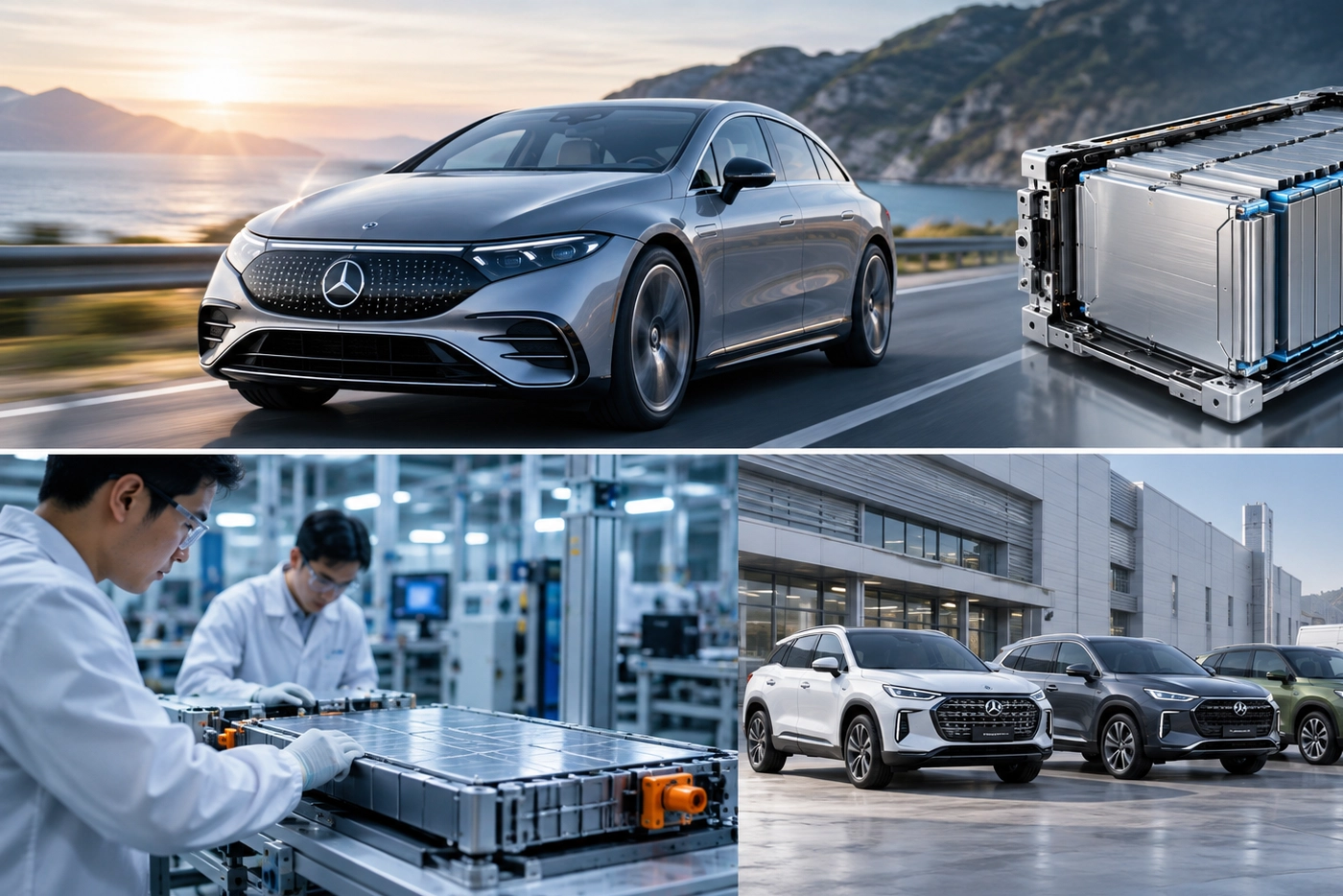
ProLogium and Mercedes have been collaborating for several years on the development of next-generation batteries and have already tested this technology in real vehicles. In one of the tests, a Mercedes EQS equipped with a ProLogium battery achieved a range of over 1,200 kilometers on a single charge.
It does not mean that future electric cars will automatically offer ranges greater than 1,000 kilometers. The result corresponds to a specific configuration and certain test conditions. However, it demonstrates how far energy density can go when you combine a new battery architecture with a vehicle designed to take advantage of it.
The major challenge remains manufacturing millions of batteries.
The start of mass production is an important step, but solid-state batteries are still far from replacing conventional batteries in high-volume electric cars.
The main challenge is no longer solely achieving high energy density. Manufacturers must demonstrate that they can mass-produce the cells, maintain consistent quality, ensure durability, and reduce costs to competitive levels.
The ProLogium plant in Taoyuan initially has a capacity of around 0.5 GWh per year, with plans to expand. The company is also building a new factory in Dunkirk, France, designed to initially reach 4 GWh and with a design capacity of up to 44 GWh.
The difference compared to the current industry remains enormous: lithium-ion batteries have been manufactured for years on a scale of tens or hundreds of gigawatt-hours.
Solid-state technology is beginning to leave the laboratory.
The true significance of ProLogium's announcement therefore lies beyond the 381 Wh/kg mark.
Technology is beginning to travel the path that separates a prototype from an industrial solution. ProLogium assures that its lithium-ceramic battery platform has already accumulated more than a decade of development and more than 2.4 million cells supplied in different applications.
The next step will be to verify whether solid-state batteries can retain their advantages when manufactured in large volumes and incorporated into electric cars destined for the mass market.
If they succeed, the next generation of electric vehicles could offer something that remains one of their main challenges today: much more autonomy without carrying increasingly larger and heavier batteries.