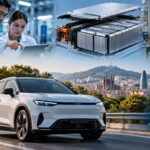




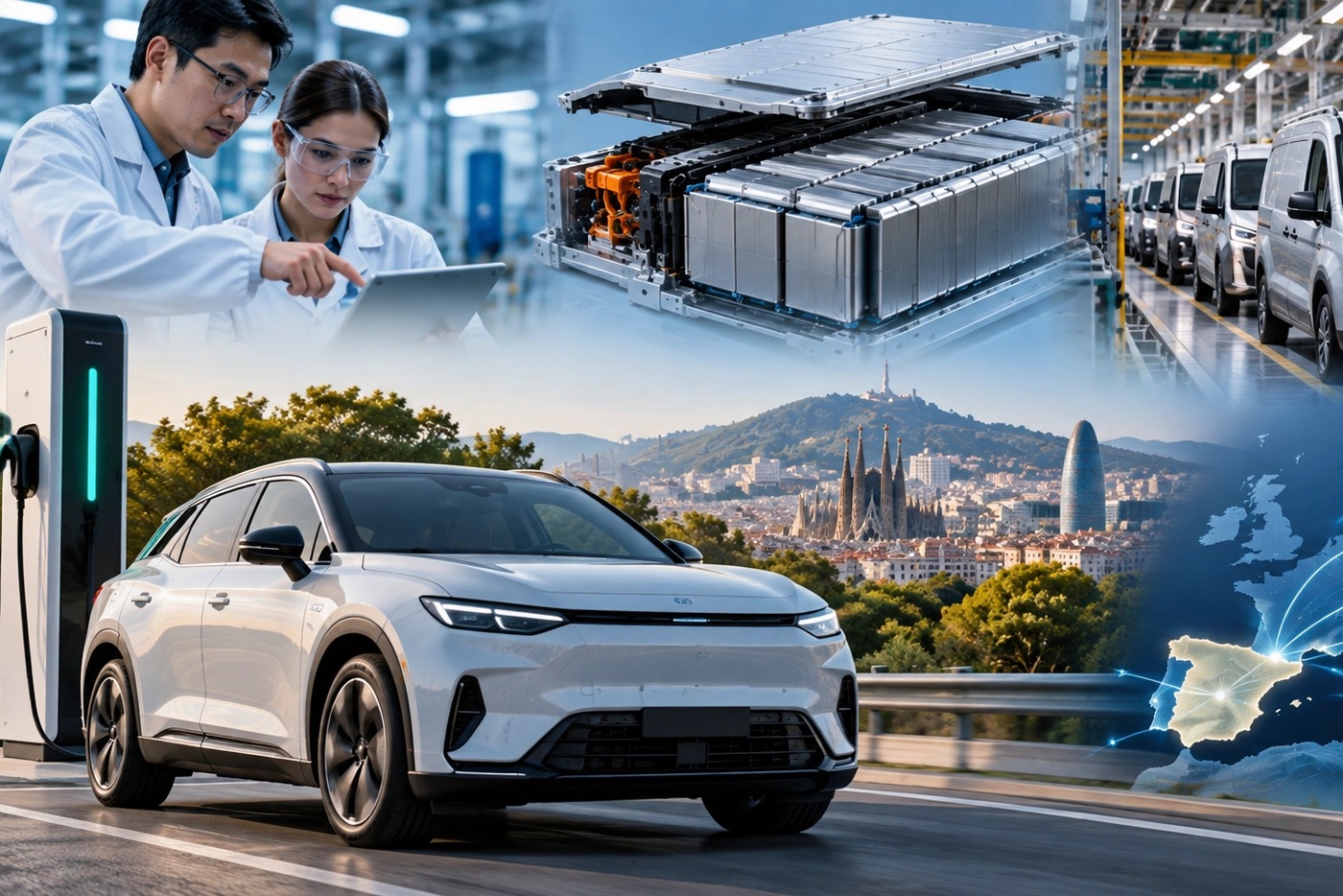
Chery prepares solid-state batteries for its electric cars: it will invest 1.28 billion and begin testing in 2027.
The race to develop solid-state batteries for electric cars is accelerating. Chery has announced an investment of 10 billion yuan—approximately 1.28 billion euros—to develop this technology and has assigned around 1,200 engineers to its battery innovation programs.
The Chinese manufacturer plans to begin the first tests of its new batteries in 2027. The goal is to achieve an energy density that doubles that of the batteries currently used in electric vehicles.
This move is particularly significant for Spain because Chery is Ebro's industrial partner and is involved in vehicle production at the former Nissan plant in Barcelona.
What can solid-state batteries offer?
The main attraction of this technology is the ability to store much more energy in the same amount of space.
The lithium-ion batteries currently used by most electric cars rely on liquid electrolytes. Solid-state batteries use a solid electrolyte—an architecture that can enable increased energy density and improved safety characteristics.
In practical terms, higher energy density offers two possibilities.
The first is to use a battery of the same size to achieve more autonomy. The second is to maintain a similar autonomy by reducing the size and weight of the battery pack.
For electric car manufacturers, both options are attractive. Greater range can reduce one of the main barriers to electric vehicles, while a lighter battery can improve vehicle efficiency.
Chery wants to double energy density.
The goal announced by Chery is particularly ambitious: the batteries the company will begin testing in 2027 are expected to double the energy density of current ones.
The company has not yet announced a specific date to begin commercial production of cars equipped with all-solid-state batteries.
Chery Chairman Yin Tongyue has stated that the company will not incorporate this technology into its vehicles until it is proven to be completely safe.
This condition shows that the development of solid-state batteries is still in a transition phase. The technology promises great improvements, but before reaching production vehicles it must pass safety, durability, manufacturing and cost tests.
A possible advantage for Ebro cars manufactured in Barcelona
The project is of special interest for Spain due to Chery's relationship with Ebro.
Ebro vehicles are manufactured at the former Nissan plant in Barcelona as part of an industrial alliance with Chery. Consequently, battery advancements achieved by the Chinese group could have medium-term implications for future electric models produced in Spain.
The advantage could be even more interesting in electric commercial vehicles.
In an electric van, the battery accounts for a significant portion of the vehicle's total weight. Reducing the weight required to store a given amount of energy would make it possible to increase the driving range without significantly compromising payload capacity.
For a delivery company, for example, it is not enough that an electric van can travel many kilometers: it must also be able to transport the greatest possible amount of merchandise within the established weight limits.
Therefore, a battery with significantly higher energy density could substantially alter the relationship between range, weight, and cargo capacity.
Solid-state still has a problem: the timeline.
Chery's announcement does not mean that its cars will use solid-state batteries in the short term.
The company itself has not yet established a commercial launch date and conditions its use on the technology reaching the necessary security levels.
Moreover, Chery is not alone in this race. Other major manufacturers and battery producers are developing similar technologies, while CATL, the world's largest battery manufacturer, has projected large-scale production of solid-state batteries for around 2030.
This allows Chery's announcement to be put into context: 2027 will be the year of the first tests, not necessarily the year of arrival of solid-state cars on the market.
A race that could change the electric car
Chery's move confirms that manufacturers consider solid-state batteries one of the key technologies for the next generation of electric cars.
The recent start of production for ProLogium’s batteries demonstrates that some solutions are already beginning to move beyond the experimental phase, while Chery’s investment shows that other manufacturers are preparing their own technologies for the coming years.
The battle will now be to ensure that the advantages on paper can be transferred to cars manufactured in large quantities and at a price that consumers can afford.
If Chery ultimately succeeds in doubling the energy density of its batteries and bringing them into production, the impact could be particularly significant for Ebro's future electric cars and commercial vehicles manufactured in Barcelona.
But first the last major obstacle will have to be overcome: converting a promising technology into a battery that can be manufactured millions of times, is safe, lasts for many years and is economically competitive.