



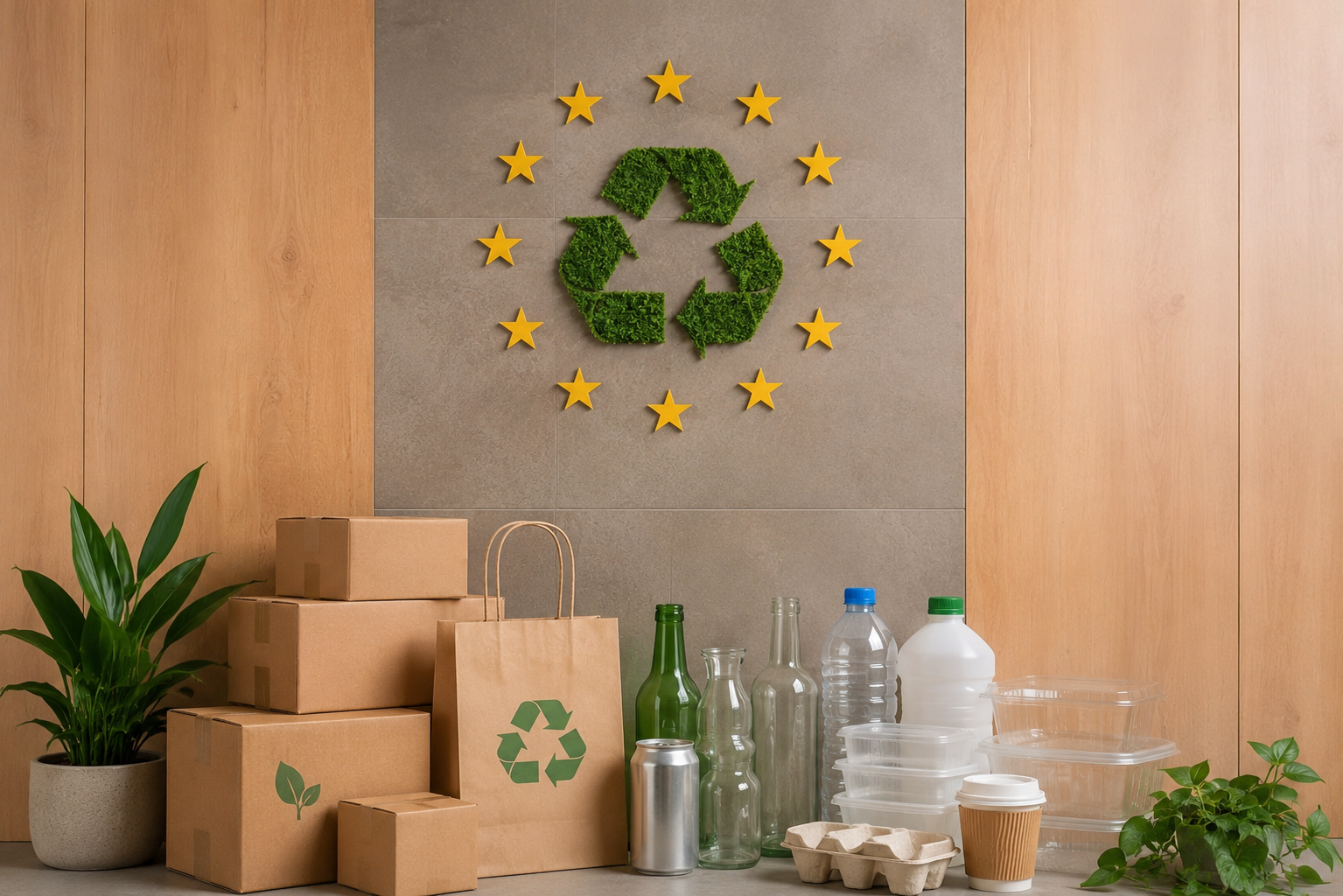
Europe launches its new packaging law: how the way packaging is produced, sold, and recycled will change starting in August 2026.
Europe is taking a decisive step toward a more circular economy with the entry into application, on August 12, 2026, of the new Packaging and Packaging Waste Regulation (PPWR). The regulation, adopted as Regulation (EU) 2025/40, replaces the previous European framework on packaging and establishes common rules for its entire lifecycle: from design and manufacturing to reuse, collection, and recycling.
The change does not mean that all obligations come into force immediately. The regulation establishes a phased timeline, with new requirements to be rolled out primarily between 2028 and 2030. The goal is to reduce the amount of waste generated, limit unnecessary packaging, and increase the use of recycled materials and reuse systems.
A change that affects the entire lifecycle of the packaging.
Until now, a significant portion of packaging regulations was structured through a European directive and various national implementing measures. The new regulation aims to establish a harmonized framework for all Member States and to cover virtually all packaging, regardless of the material used or the sector in which it is employed.
This means that manufacturers, importers, distributors, retailers, and e-commerce companies will have to progressively review how they design, produce, use, and manage their packaging.
The European Commission thus aims to reduce waste generation and facilitate the functioning of the internal market, while simultaneously boosting reuse and the market for secondary raw materials.
The first major change: limits on PFAS in food packaging
One of the measures taking effect on August 12, 2026, directly affects packaging intended to come into contact with food.
From that date, food packaging exceeding certain limits for PFAS—known as persistent chemicals or “forever chemicals”—may not be placed on the European market.
These substances have been used, among other applications, to provide water and grease resistance in certain food packaging, such as takeout containers, wrappers, microwave popcorn bags, or pizza boxes.
The Commission considers that limiting their presence will make it possible to reduce both consumer exposure and the release of these persistent substances into the environment.
Less unnecessary packaging and less empty space
One of the most significant changes for commerce—and especially for e-commerce—will arrive in 2030.
Regulations stipulate that the empty space in certain grouped sales, transport, and e-commerce packaging must not exceed 50%. The aim is to prevent products from being shipped in boxes that are much larger than necessary—a practice that increases the consumption of cardboard and other materials and generates more waste.
For e-commerce companies, this can translate into a review of box sizes, packaging systems, and the way orders are prepared.
The regulation also introduces measures to reduce certain single-use packaging formats and establishes reuse targets for sectors with high waste reduction potential.
Reuse is gaining ground over the throwaway model.
The new regulation aims to ensure that a larger proportion of packaging can be used multiple times before becoming waste.
One of the most significant targets concerns transport packaging. From 1 January 2030, economic operators using certain formats of transport packaging or sales packaging used to transport products must ensure that, overall, at least 40% are reusable within a reuse system.
The obligation also applies to products distributed via e-commerce and covers formats such as pallets, boxes, trays, plastic crates, certain containers, drums, and pallet protection systems.
For certain operations within the same company, between affiliated companies, or for specific types of transport within a single Member State, the regulation establishes even more stringent reuse targets.
The sale of beverages is also changing.
Reuse is not limited to transport.
From 2030 onwards, final distributors must ensure that at least 10% of certain alcoholic and non-alcoholic beverages are marketed in reusable packaging within a reuse system, although there are various exceptions for specific beverage categories.
Die Vorschrift legt zudem ehrgeizigere Ziele für 2040 fest.
The European approach is to shift progressively from a "make, use, and dispose" model to one in which packaging can remain within the economic loop for longer.
Recycling also begins with design.
The new regulation does not limit itself to specifying what to do with the packaging once it becomes waste; it also alters how it must be designed.
Starting in 2030, measures will come into effect aimed at ensuring that packaging is recyclable and increasing the recycled plastic content in certain types of packaging.
Recycled content targets vary depending on the format and type of plastic. For example, the regulation establishes different minimum percentages for 2030 for certain PET packaging, other plastic packaging in contact with products, and single-use plastic beverage bottles.
This will force manufacturers and brands to pay much closer attention not only to the material used but also to its composition, recyclability, and the availability of recycled materials.
New labeling to make recycling easier
Consumers will also see changes, although these will arrive gradually.
The regulation establishes that, as of 12 August 2028—or the applicable date depending on the adoption of implementing acts—packaging must bear harmonized labeling regarding its material composition to facilitate proper sorting.
The aim is for a more uniform system to make it easier to identify where each container should be deposited and to reduce the confusion caused by the existence of different information systems across countries.
Reusable packaging will also be subject to specific identification requirements. The regulations provide for the inclusion of information via a QR code or another standardized, open digital medium, enabling the provision of details regarding reuse systems and collection points, among other data.
What does this mean for companies?
The impact will be especially significant for companies that manufacture, import, distribute, or use large quantities of packaging.
Die Unternehmen werden schrittweise Aspekte überprüfen müssen wie:
The design and size of its packaging.
The amount of material used.
The real possibility of recycling them.
The percentage of recycled material incorporated.
The use of reusable formats.
Collection and reuse systems.
Information and packaging labeling.
Packaging used in logistics and e-commerce.
The European Commission acknowledges that adaptation will entail costs for operators, but maintains that harmonizing rules can reduce the complexity arising from differing national requirements in the medium term and foster new investments in circular economy solutions.
A timeline that starts now but looks toward 2030.
One of the keys to understanding the new regulations is that August 12, 2026, is not the date when all obligations change at once.
The regulation entered into force in February 2025, and its general application began on August 12, 2026. From that point on, various obligations will come into effect progressively.
August 12, 2026: general application of the PPWR begins, and restrictions on certain PFAS in food packaging—among other measures—enter into force.
August 12, 2028: the new harmonized labeling system for packaging materials is scheduled.
January 1, 2030: a significant number of structural measures come into effect, including limits on empty space, reuse targets, and specific requirements regarding recyclability and recycled content.
2040: more ambitious targets for reuse and recycled content are achieved across different categories.
Europe wants to curb the growth of packaging waste.
The scale of the change addresses a problem that the European Union views as growing. According to the Commission, without new measures, packaging waste in the EU could increase by 19% by 2030, while plastic packaging waste could rise by as much as 46%.
The PPWR aims to reverse that trend by acting before packaging becomes waste: reducing unnecessary materials, promoting reuse, increasing recyclability, and creating greater demand for recycled raw materials.
The ultimate goal is for packaging to no longer be designed solely with commercial and logistical functions in mind, but rather to become part of a much broader circular economy system.
A transformation that has already begun
The new European regulations do not mean that all packaging will suddenly become reusable tomorrow or that single-use boxes will disappear. The change will be gradual and will unfold over the coming years.
However, the message for companies is clear: packaging is no longer solely a matter of marketing, logistics, or product protection. Its design, composition, reusability, recyclability, and end-of-life management are now all part of the same European regulation.
With the implementation of the PPWR, Europe is embarking on a new phase in its waste policy: shifting from managing ever-increasing amounts of discarded packaging to ensuring—from the outset—that less is produced, more is reused, and materials can re-enter the production cycle.