






Electric trucks accelerate in 2026: BYD, Tesla and MAN take the electrification of heavy transport to another dimension
The arrival of new models with ranges of up to 720 kilometers and charging capacities exceeding 1 MW marks a turning point for road freight transport.
The electrification of road transport is no longer limited to passenger cars and vans. In 2026, large manufacturers are accelerating the development of electric trucks capable of covering long distances, with high-capacity batteries, increasingly greater charging powers and autonomy that are beginning to approach the needs of transport companies.
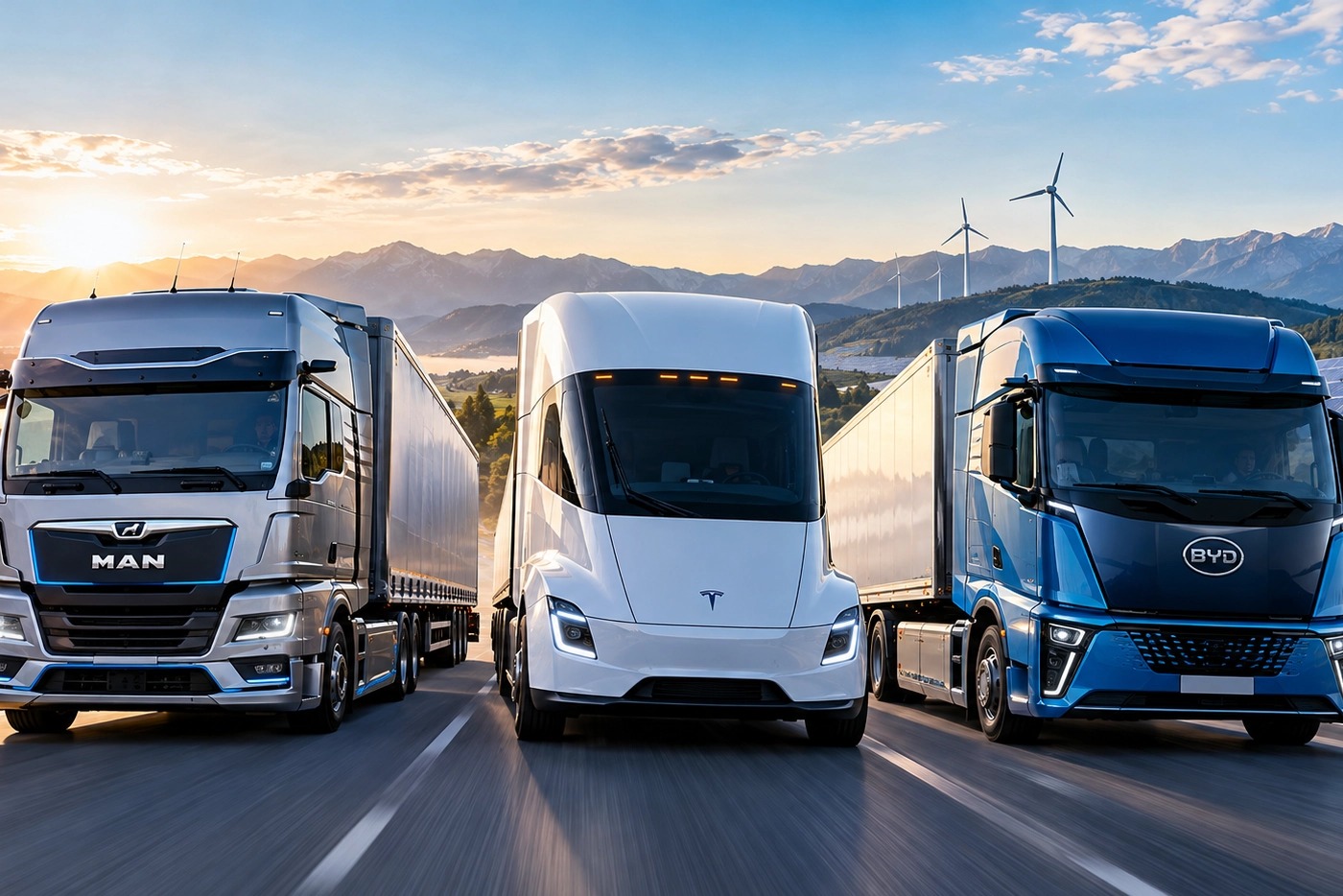
The recent IAA Transportation 2026—one of the sector's premier international events—showcased the extent of this transformation. MAN, Tesla, and BYD presented their offerings for electric heavy-duty transport, part of a technological race that also carries implications for fossil fuel consumption and transport emissions.
However, the change is still far from complete. The availability of charging infrastructure continues to be one of the main obstacles, especially in countries like Spain.
MAN eTGX: up to 720 kilometers of range
One of the protagonists of the IAA Transportation 2026 has been the MAN eTGX, an electric tractor designed specifically for long-distance heavy transport.
The new generation incorporates aerodynamic improvements and a battery with up to 10% more usable energy without increasing weight. In the 4×2 configuration, it can achieve a range of up to 660 kilometers, while the 6×2 version—equipped with a seventh battery—reaches up to 720 kilometers, according to figures announced by MAN.
The model also incorporates a high-power electric motor and improved energy recovery systems. For professional transport, one of the fundamental aspects will be to combine these features with sufficiently short recharging times so that stops do not penalize fleet activity.
Tesla Semi: 550 kilometers and ultra-fast charges
Tesla has also brought its Semi to the European market. The American electric truck, originally presented in 2017, has accumulated several years of delays, but in 2026 the company is taking the step towards its commercialization in Europe.
The European Standard Range version features a 548 kWh battery and an advertised range of up to 550 kilometers. Its powertrain can deliver a power output of 800 kW and supports charging at up to 800 kW via the MCS 3.2 system.
One of its main arguments is precisely the charging speed: Tesla ensures that the Semi can recover up to 60% of its autonomy in approximately 30 minutes in conditions compatible with its charging infrastructure.
BYD bets on 651 kWh batteries.
Another especially relevant proposal comes from China. BYD ETT 44 is designed as a 44-tonne electric tractor unit and uses a 651 kWh Blade battery with LFP technology, a lithium-ferrophosphate-based chemistry.
The truck can achieve a maximum power output of nearly 1,000 hp and boasts an exceptionally high load capacity. With the MCS system, BYD announces power outputs exceeding 1.5 MW, which would allow the battery charge to go from 20% to 80% in approximately 20 minutes.
BYD has also announced its intention to produce trucks in Europe and begin introducing its first heavy truck into the European market during 2027. The company thus seeks to bring manufacturing closer to its European customers and reduce the impact of tariffs and import logistics.
Europe increases sales of electric trucks.
The evolution of these models coincides with a growth in registrations of zero-emission heavy vehicles in Europe.
More than 6,355 zero-emission heavy-duty vehicles were registered in the European Union during the first quarter of 2026. For trucks exceeding 12 tonnes, registrations rose from around 900 units in the first quarter of 2025 to approximately 1,600 in the same period of 2026, increasing their market share from 1.4% to 2.3%.
The data therefore shows that growth exists, although the electric truck still represents a small part of the heavy transport market.
Spain faces one of its major challenges: infrastructure.
Technological development contrasts with the situation of Spanish infrastructure.
Between January and June 2026, only 32 electric trucks weighing over 16 tonnes were registered in Spain, compared to 60 registered during the same period in 2025. This decline contrasts with the growth observed in other European markets.
One of the problems pointed out by the sector is the shortage of adequate charging points for heavy vehicles. Spain had around 24 stations capable of offering power of at least 350 kW and with appropriate characteristics for trucks, according to data collected by Cinco Días.
This presents a paradox: manufacturers are developing trucks with increasingly large batteries and charging systems capable of exceeding one megawatt, yet the infrastructure needed to use them is still growing at a much slower pace.
The electric truck enters a new phase.
New models from MAN, Tesla, and BYD demonstrate that the technology needed to electrify a significant portion of heavy transport is advancing rapidly. Improvements in range, efficiency, and charging speed are reducing some of the barriers that until recently limited these vehicles.
However, the transition will not depend solely on manufacturers. The expansion of charging networks, the price of electricity, aid to companies, the availability of power and the characteristics of the routes will be decisive in deciding where and when it is viable to replace a diesel truck with an electric one.
Heavy transport is thus undergoing a progressive transformation in which the electric truck is ceasing to be an experimental alternative and becoming a commercial option for specific types of routes and operations.