





Uneven distribution of hot air can increase the energy consumption of an industrial building or large space. Air destratifiers offer a solution to recover the heat accumulated in the upper areas and distribute it more evenly.
In large buildings, such as industrial warehouses, storage facilities, sports centers, or agricultural spaces, there is a common phenomenon that can easily go unnoticed: air stratification. Warm air rises and tends to concentrate near the ceiling, while areas near the floor remain cooler.
This temperature difference can cause heating systems to work longer to maintain comfortable conditions in the occupied area. One solution designed to combat this problem is the Eliturbo air destratifier, available at Arelia.
What is an air destratifier?
A destratifier is a piece of equipment designed to mix and redistribute the air that has accumulated at different heights in a building.
In the case of Eliturbo, the system uses a patented helico-centrifugal turbine that promotes mixing between the layers of warm air located in the upper areas and the cooler air near the floor. This allows heat to return to the occupied area without creating uncomfortable drafts.
The goal is not simply to move the air, but to achieve a more homogeneous temperature throughout the space.
Less stratification, greater heat utilization
One of the main benefits of destratification is to make better use of the energy that is already being generated.
When heat accumulates at the top of a building, the temperature in the work area can be considerably lower. By mixing the different layers of air, the system helps to recover some of that heat and distribute it to the lower areas.
According to TECNA's technical documentation, Eliturbo can achieve reductions in energy consumption for heating of between 20% and 40%, depending on the characteristics of the installation and the operating conditions.
For this reason, destratifiers can be used as a complement to hot air generators and air heaters.
Eliturbo 2000: a solution for large spaces
Within the Eliturbo range, the Eliturbo 2000 is designed for large-volume installations and can work in spaces with heights of up to approximately 8 meters, according to its technical specifications.
The single-phase model operates at 230 V / 50 Hz, incorporates a 220 W motor, and achieves an airflow of 4,920 m³/h. Its operating radius is approximately 7 meters, and its coverage area reaches 200 m².
The unit has approximate dimensions of 680 mm in diameter by 585 mm in height and a weight of 10 kg, which facilitates its integration into installations where an air distribution solution is needed without resorting to a duct network.
A technology designed for different sectors
Although destratification is especially related to the heating of industrial buildings, its applications are broader.
Eliturbo can be used in:
- Industrial buildings and warehouses, to improve temperature distribution.
- Sports facilities, where it can also help reduce condensation problems.
- Greenhouses, helping to distribute temperature and humidity more evenly.
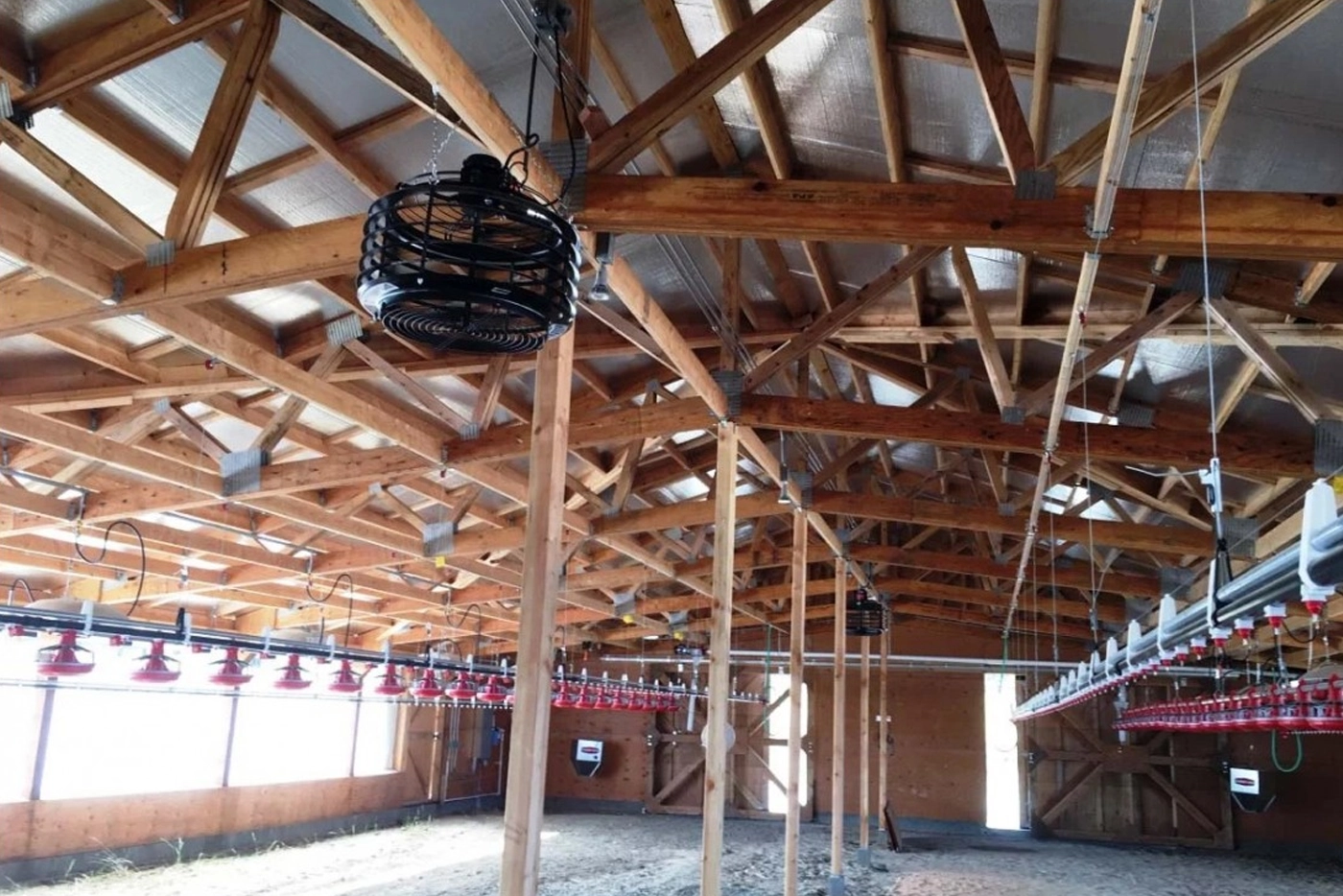
- Livestock farms, promoting air circulation and reducing the concentration of certain gases.
- Museums and places of worship, where controlled air circulation can help prevent condensation and problems arising from humidity.
This variety of applications makes destratification an interesting technology not only from an energy point of view, but also for the management of comfort and indoor environmental conditions.
An alternative to improve the efficiency of existing facilities
One of the advantages of this type of solution is that it does not necessarily require replacing the entire heating system.
Destratifiers can be installed as an addition to existing heating systems to improve the distribution of thermal energy. The goal is to ensure that a greater proportion of the heat produced actually reaches the area where it is needed.
Furthermore, Eliturbo is designed to distribute air radially and generate ventilation that is virtually imperceptible to people, avoiding the feeling of direct draft that other ventilation systems can produce.
Energy efficiency also starts with making better use of heat.
Reducing energy consumption doesn't depend solely on installing more efficient heating equipment. In large buildings, preventing heat loss and making good use of the heat generated can also make a significant difference.
Destratification addresses precisely this problem: preventing heat from accumulating in the upper areas and promoting a more uniform temperature distribution.
The Eliturbo 2000 single-phase thus represents a solution aimed at improving the performance of heating systems in certain industrial and commercial spaces, combining air circulation, comfort and energy efficiency.
The product is available at Arelia., within its range of air conditioning and energy efficiency solutions.