






The freight train, a key element for the energy transition
Growing geopolitical instability and volatile energy markets are highlighting the need to transform current transportation systems. Every international conflict affecting major oil producers leads to significant increases in fuel prices, generating additional costs for businesses, consumers, and national economies.
In this context, rail freight emerges as one of the most efficient, sustainable, and competitive solutions for reducing energy dependence and moving towards a low-carbon economy. Its ability to move large volumes of cargo with significantly lower energy consumption than road transport makes it a strategic tool for the future of logistics in Europe.
Why is rail freight transport more efficient than road transport?
Freight trains offer numerous advantages over truck transport, especially for medium and long-distance journeys. Their energy efficiency, lower environmental impact, and high cargo capacity make them one of the most sustainable options for moving goods.
Lower CO₂ emissions
One of the main benefits of rail transport is its contribution to combating climate change. Rail transport can emit up to five times less carbon dioxide per tonne transported and kilometer traveled than road transport.
This reduction in emissions is essential to achieving European decarbonization goals and to moving towards more environmentally friendly logistics systems.
Large transport capacity
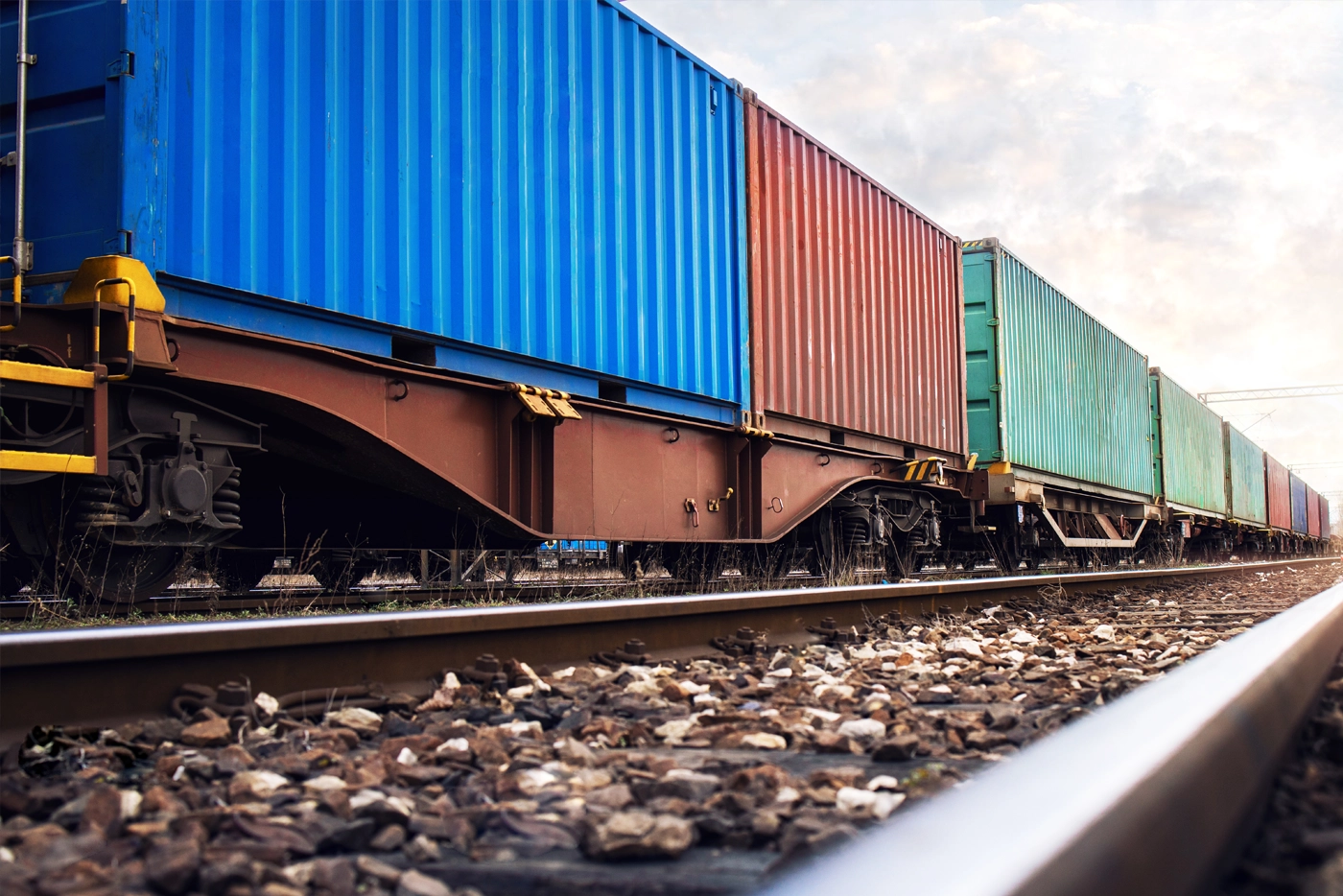
A single freight train can carry a load equivalent to between 50 and 80 trucks. This capacity significantly reduces the number of heavy goods vehicles on the road, decreasing road congestion and improving the overall efficiency of the transport network.
More competitive logistics costs
For long-distance and high-volume shipments, the cost per ton transported can be between 30% and 40% lower than that of road transport. This represents a significant economic advantage for industrial sectors, distributors, and logistics operators.
Greater safety and fewer accidents
Rail transport has considerably lower accident rates than road transport. Furthermore, by running on dedicated infrastructure, it reduces the risks associated with traffic, weather conditions, and theft during stops.
Punctuality and reliability
Unlike road transport, trains do not suffer from traffic jams or restrictions related to holidays or weekends. This allows for more stable and predictable logistics planning, especially on international corridors.
Reduced wear and tear on road infrastructure
Reducing heavy traffic helps to decrease the deterioration of roads and highways, also reducing the maintenance costs of public infrastructure.
The role of rail in the European Union's sustainable transport strategy
The European Union considers rail freight transport a fundamental tool for building more sustainable and efficient mobility. Through the Trans-European Transport Network (TEN-T), Brussels is promoting the improvement of rail corridors and the development of intermodal transport.
One of the European strategic objectives is to transfer a significant part of the freight transport currently carried out by road to more sustainable modes, especially rail and short sea shipping.
To this end, the EU is promoting investments in infrastructure, digitalization, interoperability between national networks, and improvements to international rail services. Thanks to these initiatives, goods can move between different European countries through integrated logistics systems and increasingly competitive transit times.
The situation of rail freight transport in Spain
Despite the clear advantages of rail transport, Spain continues to have one of the lowest rail freight rates in Europe. While in some central European countries rail transports close to 30% of land freight, in Spain its share remains small.
Among the factors that explain this situation are the historical limitations of the railway network, the complexity arising from the different track gauges and less investment in corridors specifically oriented to freight transport.
For decades, much of the railway investment has focused on developing high-speed passenger lines. While this infrastructure has improved connectivity between cities, many experts believe that increased investment in logistics corridors is also necessary to boost industrial competitiveness and reduce reliance on road transport.
France and Germany: examples of a balanced rail network
Countries like France and Germany have opted for more balanced railway models, combining passenger transport with freight transport in numerous corridors.
The modernization of conventional lines, the improvement of cargo capacity, and the integration of logistics services have enabled the development of more homogeneous and efficient networks. These infrastructures facilitate the large-scale movement of goods, reduce energy costs, and strengthen the economic competitiveness of their industries.
The future of sustainable logistics lies in rail.
The transition to a decarbonized economy requires a profound transformation of current transport systems. In this scenario, freight rail emerges as a strategic solution capable of combining sustainability, energy efficiency, safety, and economic competitiveness.
Increasing investment in railway infrastructure, improving network interoperability, and boosting intermodal transport will be fundamental steps for Europe and Spain to move towards more sustainable and resilient logistics.
The development of rail freight transport will not only help reduce emissions and energy consumption, but will also allow us to build a more competitive economy, better prepared to face the challenges of the future.